AQA · GCSE · English Language
Explorations in creative reading and writing
This topic focuses on developing your ability to critically analyse how writers use language and structure in unseen fiction texts, and then applying those same techniques to produce your own engaging, accurate creative writing. It tests your reading comprehension (AO1, AO2, AO4) alongside your written communication and technical accuracy (AO5, AO6).
- 7 min read
- 3 worked examples
- 5 practice questions
- 8 key terms
Study Notes
Overview
GCSE English Language Paper 1 — Explorations in Creative Reading and Writing — is designed to test your ability to read closely and write creatively. The paper is split into two halves: Section A focuses on reading an unseen fiction extract (usually from the 20th or 21st century), and Section B requires you to produce your own piece of descriptive or narrative writing. The core principle of this paper is that reading and writing are deeply connected skills. By understanding how professional writers craft their narratives, build tension, and describe settings, you can borrow those same techniques to elevate your own creative writing.
Listen to our comprehensive revision podcast to lock in the key concepts:
Reading Skills (Section A)
Identifying Information & Ideas (AO1)
The foundation of reading analysis is the ability to locate specific information within a text. In the exam, you will be asked to identify explicit details (things directly stated) and implicit ideas (things suggested or implied). For lower-tariff questions, examiners are simply looking for you to extract the right information. You must select relevant details rather than copying out whole paragraphs. Read the designated lines carefully and list exactly what the question asks for.
Analysing Language (AO2)
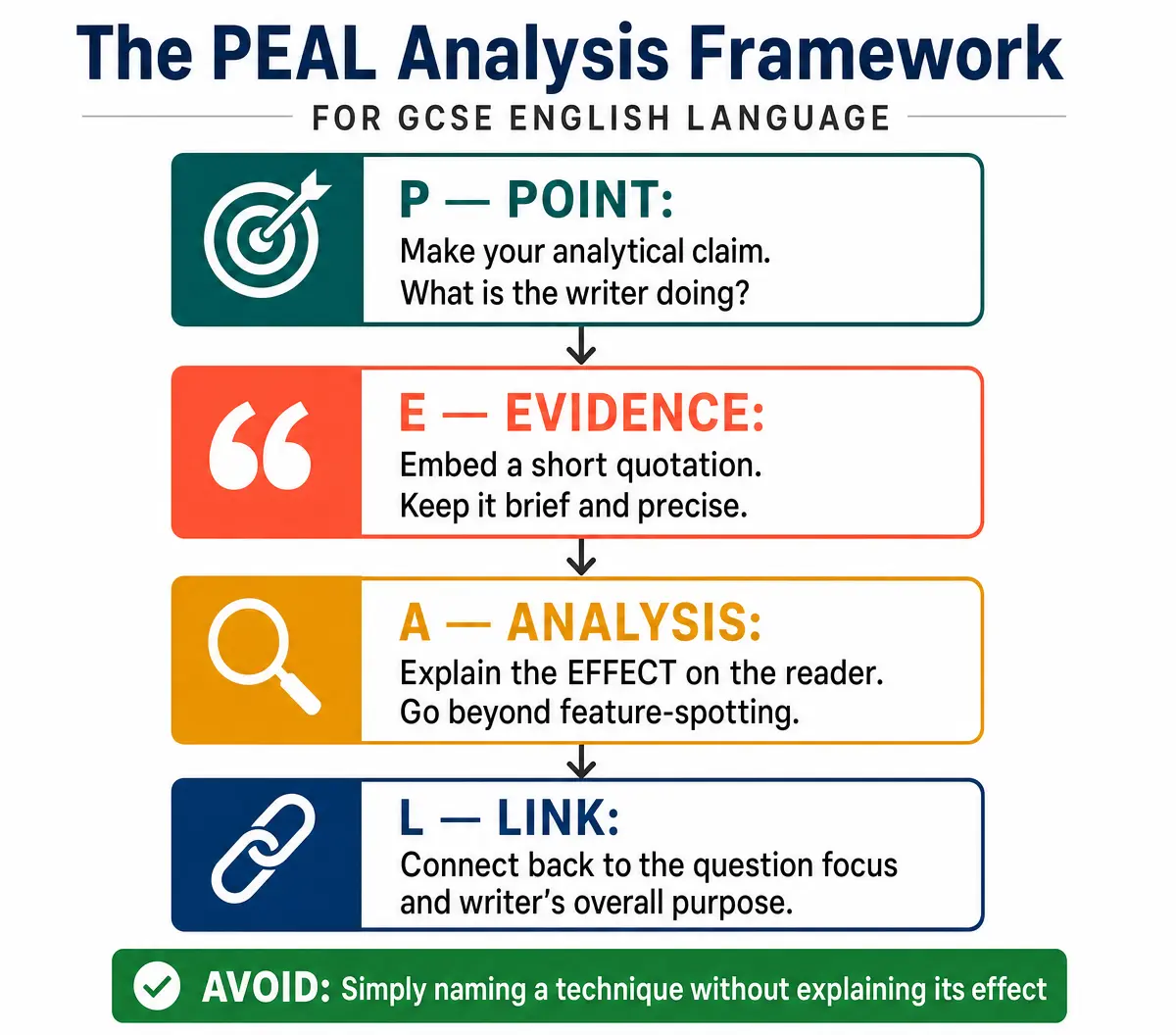
Language analysis is where you demonstrate your understanding of the writer's craft. Examiners are looking for you to identify specific language techniques, embed short, precise quotations, and explain the effect on the reader. This means moving beyond simply naming a feature (e.g., 'the writer uses a simile') to exploring why that feature was chosen and how it shapes meaning.
Key Language Features to Identify
| Feature | Definition | Effect on Reader | Example |
|---|---|---|---|
| Metaphor | Describing something as if it were something else, without using 'like' or 'as'. | Creates a vivid, striking image; often conveys deeper meaning or emotional resonance. | 'The city was a concrete jungle.' |
| Simile | Comparing two things using 'like' or 'as'. | Helps the reader visualise something unfamiliar by comparing it to something familiar. | 'The wind howled like a wounded animal.' |
| Personification | Giving human qualities to non-human things. | Can make settings or objects seem alive, threatening, or sympathetic, altering the atmosphere. | 'The shadows crept across the room.' |
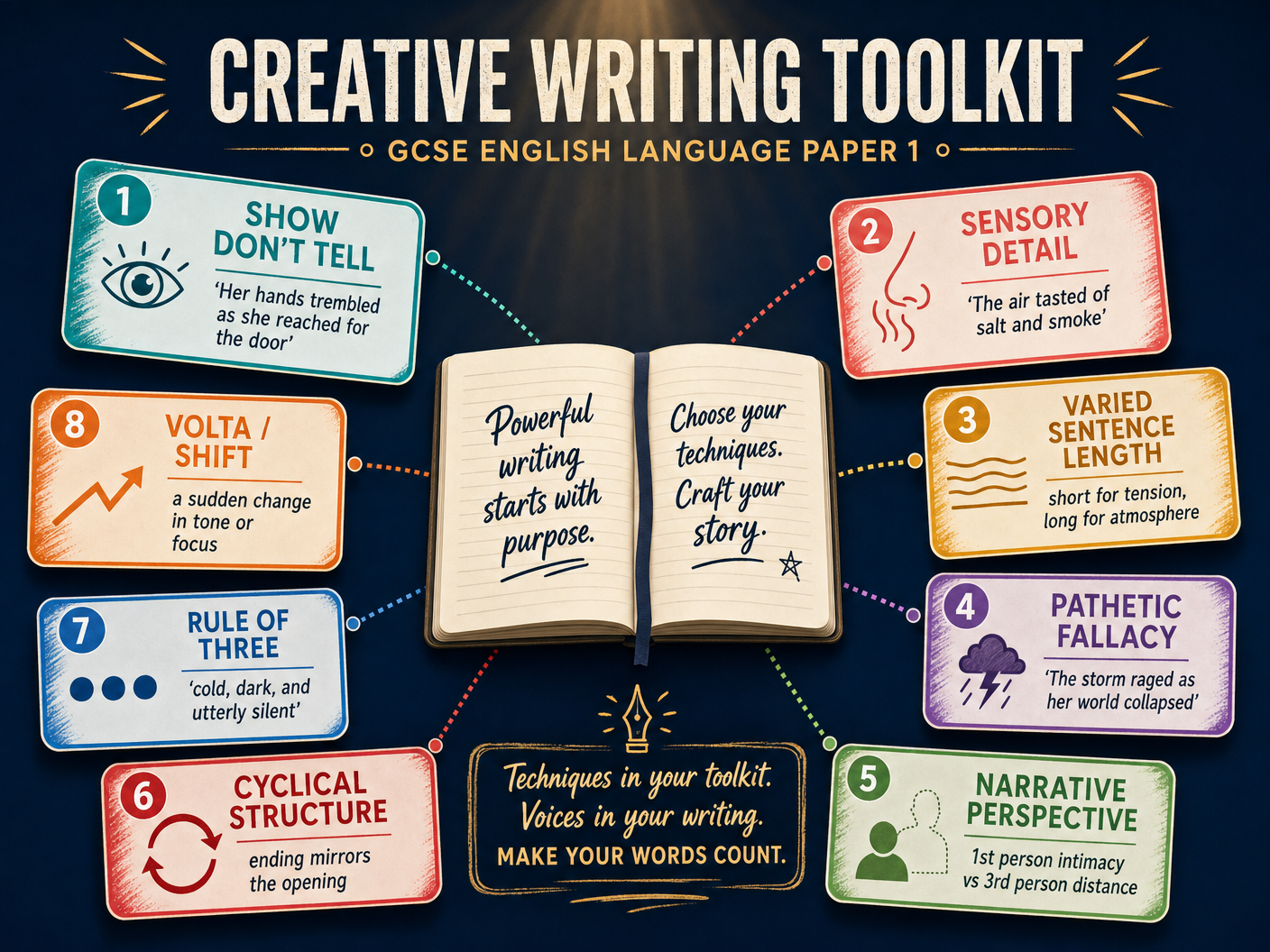
| Pathetic Fallacy | When the weather or environment reflects human emotions. | Sets the mood instantly and foreshadows future events or character feelings. | 'A heavy, oppressive storm gathered overhead.' |
| Semantic Field | A group of words related to a specific theme or topic. | Builds a consistent atmosphere or highlights a particular theme subtly throughout a passage. | Words like 'barren', 'dust', 'withered' (semantic field of decay). |
| Sensory Language | Words that appeal to the five senses (sight, sound, smell, touch, taste). | Immerses the reader in the scene, making the description feel tangible and real. | 'The sharp tang of salt stung her lips.' |
Analysing Structure (AO2)
While language analysis focuses on the micro-level (words and sentences), structure analysis focuses on the macro-level (how the text is put together). Examiners want to see that you understand how the writer guides the reader through the text. You need to consider what the writer focuses on at the beginning, how and why that focus changes, and what impact the ending has.
Key structural features include:
- Openings: Does the text start in media res (in the middle of the action) to create immediate tension, or does it establish setting first?
- Shifts in Focus: Does the narrative shift from the external environment to a character's internal thoughts? Does it zoom in on a specific detail or pan out to a wide view?
- Narrative Perspective: Is the text written in the first person (creating intimacy and bias) or third person (creating distance or an omniscient overview)?
- Pacing: How does the writer use sentence length and paragraphing to speed up the action (short sentences) or slow it down (long, descriptive sentences)?
- Cyclical Structure: Does the ending return to an idea or image from the beginning, creating a sense of inevitability or closure?
Evaluating Critically (AO4)
Evaluation is the highest-level reading skill. You will be given a statement about the text and asked 'to what extent do you agree?' To succeed here, you must form a clear, critical opinion and support it with detailed textual analysis.
An effective evaluation response follows a clear structure:
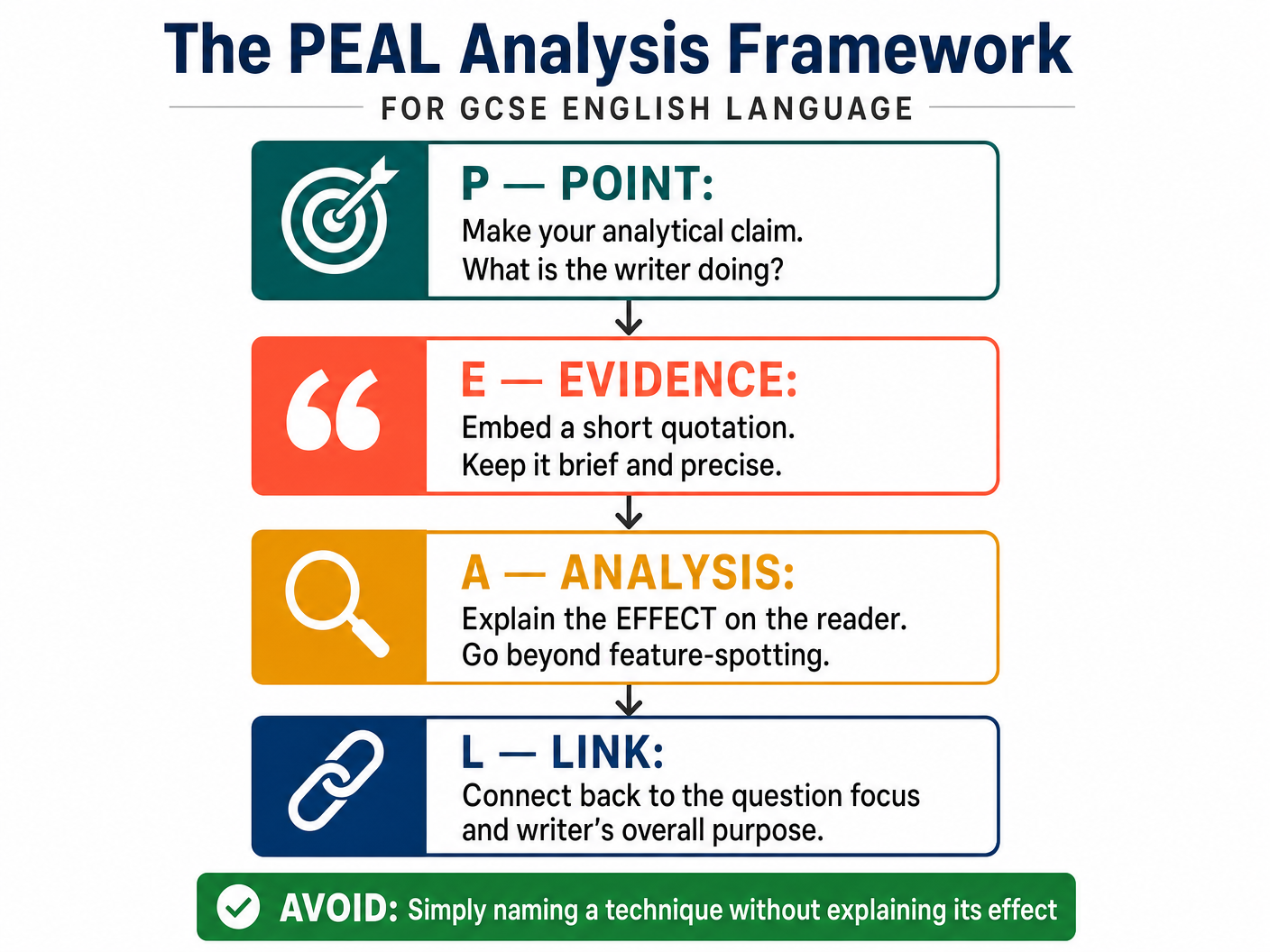
- Statement: Clearly state your overall view (e.g., 'I agree to a significant extent that the writer creates a terrifying atmosphere...').
- Evidence: Select a highly relevant quotation.
- Analysis: Examine the writer's methods (language or structure) within that quotation.
- Link: Explain how those methods support the statement provided in the question.
Strong candidates will often explore both sides of the argument — acknowledging where a statement might be less true — before reaching a reasoned conclusion.
Writing Skills (Section B)
Creative Writing (AO5 & AO6)
In Section B, you must produce a piece of creative writing, usually either a description based on an image or a narrative based on a prompt. This task assesses your ability to communicate clearly and imaginatively (AO5) and your technical accuracy (AO6).
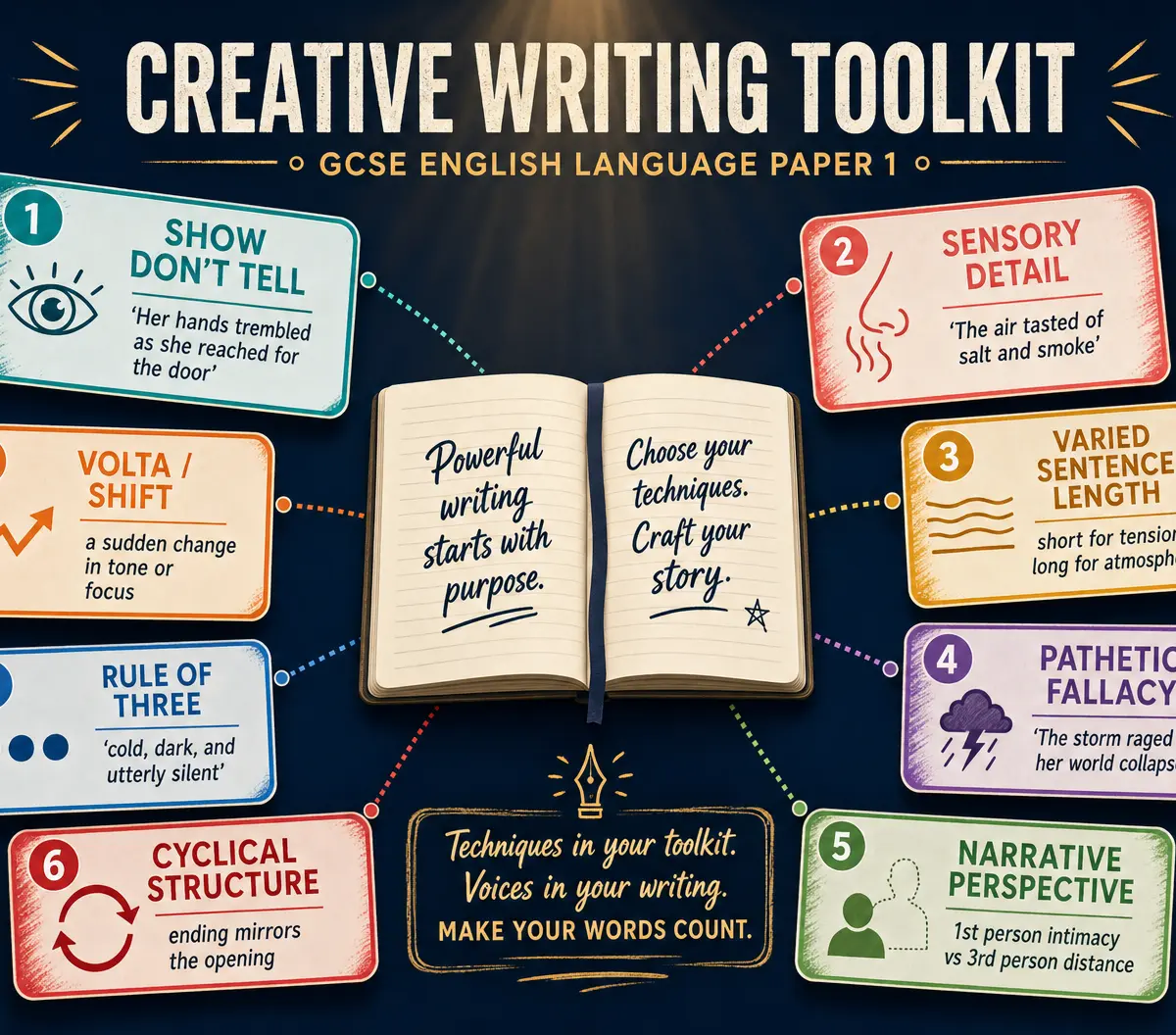
To achieve high marks, you must plan your response. A well-structured, cohesive piece of writing will always score higher than a rambling, unplanned story.
Key Techniques for Creative Writing:
- Show, Don't Tell: Instead of stating a character's emotion ('He was nervous'), describe their physical reactions ('His hands trembled as he reached for the handle').
- Sensory Description: Build your setting using all five senses to create a multi-dimensional world.
- Varied Sentence Structures: Use short sentences for impact and tension, and longer, complex sentences for detailed description and flow.
- Ambitious Vocabulary: Select precise, evocative words. Avoid generic verbs like 'walked' or 'said' in favour of 'trudged', 'stumbled', 'whispered', or 'bellowed'.
- The One-Scene Rule: For a 45-minute exam, do not try to write an epic novel spanning years. Focus on a single scene, a single moment of tension, or a short sequence of events. Depth is far better than breadth.
Technical Accuracy (SPaG)
Your spelling, punctuation, and grammar (SPaG) account for a significant portion of your Section B marks. Examiners look for:
- Sentence Demarcation: Consistent and accurate use of full stops and capital letters.
- Ambitious Punctuation: Correct use of semi-colons, colons, dashes, and parenthetical commas to enhance meaning.
- Paragraphing: Using paragraphs logically to organise ideas, indicate shifts in time or place, or introduce dialogue.
- Spelling: Accurate spelling of complex and ambitious vocabulary.
Always leave at least five minutes at the end of the exam to proofread your work. Catching simple errors can easily bump you up into the next mark band.
Interactive Diagrams
2 interactive diagrams to visualise key concepts
Conceptual Flow Outline
Section A: Reading Question Approach
Conceptual Flow Outline
Section B: Creative Writing Workflow
Worked Examples
3 worked examples — open one to explore the question and available guidance.
Practice Questions
Test your understanding — click to reveal model answers
Read lines 10 to 15. List four things you learn about the character's appearance. [4 marks]
Hint: Only look at lines 10 to 15. Do not include personality traits, only physical appearance.
How does the writer use language here to describe the heat of the day? [8 marks]
Hint: Look for adjectives, verbs, and imagery (similes/metaphors) related to temperature and discomfort.
You now need to think about the whole of the source. How has the writer structured the text to interest you as a reader? [8 marks]
Hint: Think about the 'camera lens'. Where does the text start? When does the focus change? How does it end?
A student said, 'In this part of the text, the writer makes the main character seem completely unlikable and selfish.' To what extent do you agree? [20 marks]
Hint: Form an opinion. You can agree, disagree, or partially agree. Find evidence to support your view and analyse the writer's methods.
Write a story about a time when a secret was revealed. [24 marks for content, 16 marks for technical accuracy]
Hint: Plan your narrative arc. Focus on building tension before the reveal, rather than rushing to the secret immediately.